 Aurora
Creator Q&A
Clear answers about collection ownership, mint payments, artwork, royalties and the controls you keep as a creator.
On this page
1. Who owns my collection’s smart contract—me or Aurora?
Your wallet owns the collection. The wallet that deploys it receives the owner permissions, including control over mint settings, artwork updates, royalties and mint proceeds.
Aurora provides the tools to manage the collection. Its deployment factory does not become your collection’s administrator.
2. What happens to my NFTs if Aurora goes offline?
Your minted NFTs and their ownership records remain on the blockchain. They do not disappear when Aurora’s website is unavailable.
You can continue using available contract functions through a block explorer or another compatible interface. Artwork display also depends on its storage provider and the marketplace retrieving it.
Public mints require Aurora’s mint authorization service. An outage can interrupt new public minting, but does not give Aurora control over your NFTs or retained proceeds.
3. Can Aurora upgrade or replace my collection’s contract?
No. The deployed collection’s implementation is fixed. Neither Aurora nor the collection owner can replace its underlying code.
The owner can adjust the settings explicitly supported by the contract. Replacing a transfer validator, for example, changes transfer validation without upgrading the collection itself.
4. Who controls artwork and metadata updates after minting?
The collection owner does. Updates require an owner-authorized blockchain transaction.
This lets you complete a reveal, correct metadata or maintain your collection over time. Collectors retain ownership of their NFTs when you update their metadata.
5. Can I move my artwork and metadata to another storage provider?
Yes. The contracts support metadata references without restricting them to a particular storage protocol.
This supports a sustainable long-term setup: if your storage needs change or a provider becomes unavailable, you can publish a new reference to another suitable provider, including one offering immutable storage.
Wallets and marketplaces must also support the reference format you choose.
6. Can I permanently freeze the metadata?
There is no separate metadata-only freeze switch. Keeping metadata editable preserves your ability to correct issues and move between storage providers.
An immutable storage reference identifies a fixed version of a file, while the collection owner retains the ability to point to a new version. Permanently giving up all owner controls is a separate decision, explained below.
7. How do creator royalties work, and are they supported by OpenSea?
You choose the royalty recipient and percentage, up to 10%. These are secondary-sale royalties, separate from the money received when collectors mint.
Aurora uses Limit Break’s creator token standards. OpenSea supports royalty enforcement for ERC-721-C and ERC-1155-C through compatible validator configurations and trading routes. The correct configuration matters; selecting the token standard alone does not guarantee royalties on every resale.
8. Can I change the transfer validator later—for example, after a security update?
Yes. The collection owner can replace the active validator using updateTransferValidator.
This gives you a way to move to a compatible replacement when security requirements or marketplace integrations change, while keeping the same collection and NFTs.
The replacement’s security policies and marketplace settings should be checked and configured as part of that change.
9. Can I temporarily disable the validator for bulk NFT transfers?
Yes. Setting the validator to the zero address disables it. The owner can restore the previous validator or choose a compatible replacement afterward.
While disabled, validator-based royalty enforcement and other validator restrictions stop. Your royalty settings remain recorded, but enforcement through that validator is inactive.
Normal wallet approvals, network gas and the collection’s trading lock still apply. Disabling the validator does not give the creator permission to move collectors’ NFTs.
10. Can mint payments go straight to the artist’s wallet?
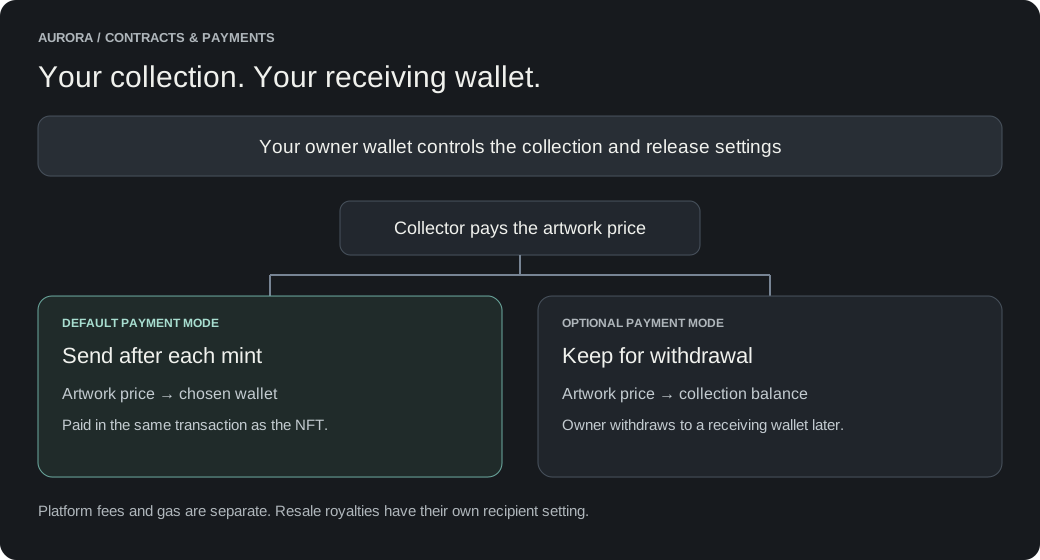
Yes. Set the artist’s address as the Mint proceeds wallet.
Aurora defaults to Send to wallet after each mint. The contract forwards the artwork price to that wallet in the same successful transaction as the mint.
The receiving wallet can be different from the collection owner’s wallet. Receiving mint payments does not grant it administrative permissions.
11. Does Aurora hold my mint proceeds?
Aurora does not hold your mint proceeds in an offchain account.
With direct payments enabled, the contract forwards the artwork price to your chosen wallet. If you choose Keep in contract for withdrawal, proceeds accumulate in your collection contract until its owner authorizes a withdrawal.
Aurora’s platform fee is handled separately from your artwork price.
12. Can I change the payment wallet or withdraw without Aurora’s website?
Yes. The owner can change the receiving wallet or payment mode for future mints of an open release. Aurora pauses the release while applying those changes.
Previously retained proceeds remain available for withdrawal. Switching to direct payments does not automatically move that earlier balance.
The owner can withdraw through Aurora or directly through a block explorer such as Basescan, choosing the recipient and amount.
13. Can I transfer ownership to another wallet?
Yes. Ownership transfer uses two steps: the current owner nominates the new wallet, and the new wallet accepts.
This helps prevent ownership from being handed over before the receiving wallet confirms. Any pending scheduled reveal must first be completed or cancelled.
Changing your mint-payment wallet or royalty recipient does not transfer collection ownership.
14. Can I permanently give up the owner permissions?
Yes. You can renounce ownership.
Before allowing it, the contract requires minting to be permanently closed, trading to be enabled, retained proceeds to be withdrawn and any pending reveal to be resolved.
Renouncing is irreversible. It removes all owner controls, including metadata updates and the ability to replace or restore a validator. It is a final step for a collection that no longer needs owner administration.
15. How do scheduled reveal and Force reveal work?
Scheduled reveal lets you announce when the final artwork is planned to appear. When it is due, you complete the reveal with your wallet.
Force reveal lets you publish earlier, including when minting has stopped or finished. Both Aurora workflows end the current release and remove the countdown after confirmation.
You can create another release with new mint phases later, provided you have not permanently closed minting for the whole collection and any lifetime supply limit still allows it.